
CBSE Scheme of Studies for Languages in Classes IX & X (2026-27 onwards) with NCERT Syllabus
CBSE/Acad/SoS/2026
Date: 15.05.2026
Circular No: Acad-33/2026
To,
All the Heads of Schools affiliated to CBSE
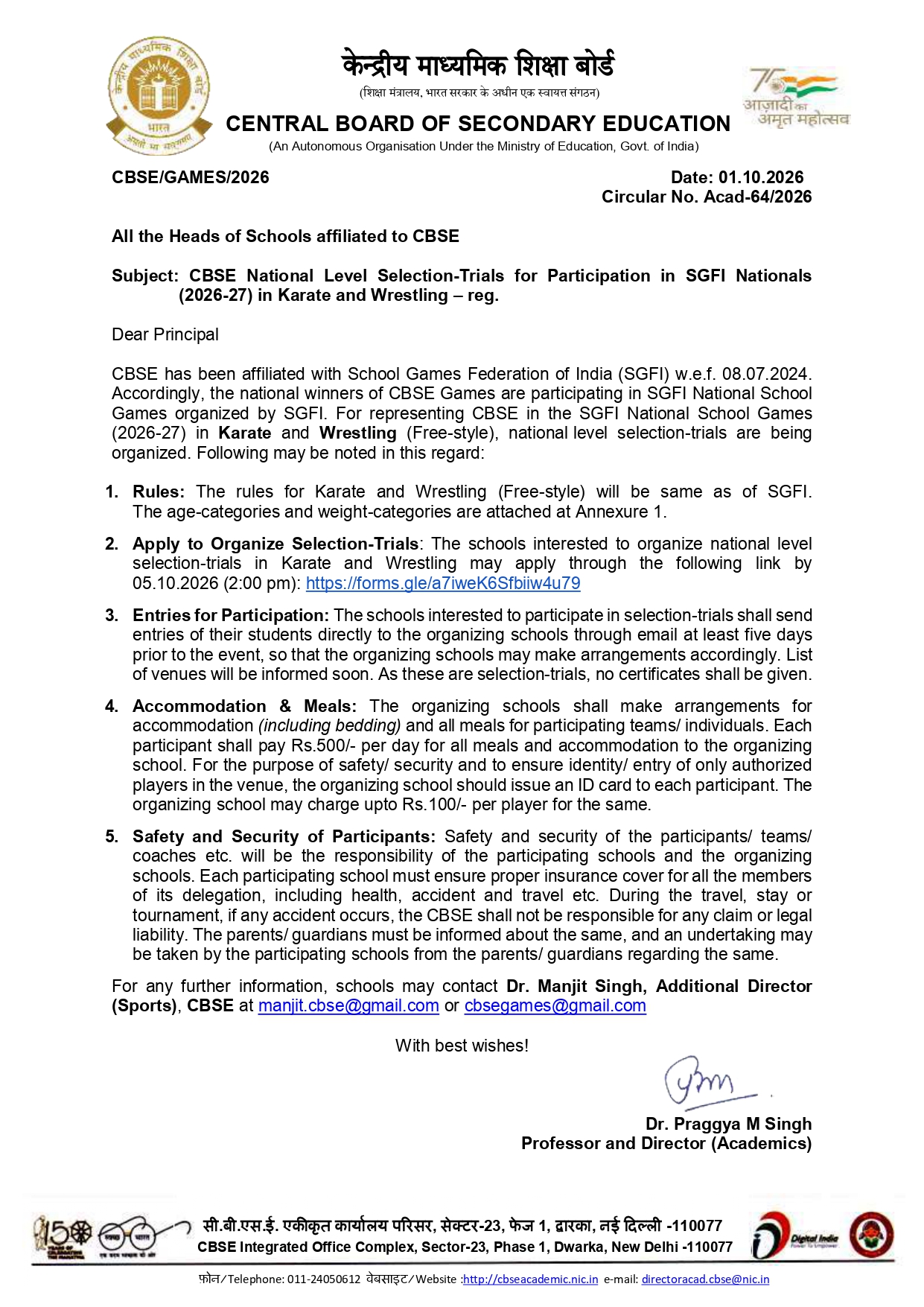
Subject: Alignment of Scheme of Studies for Languages in Classes IX & X (2026-27 onwards) with NCERT Syllabus
Dear Principal,
CBSE has always been committed to the vision of the National Education Policy (NEP) 2020 and the National Curriculum Framework for School Education (NCF-SE) 2023. In this context, the Board has carefully reviewed the recently released NCERT syllabus for Class IX (2026-27), which includes the study of three languages (R1, R2, R3) at the Secondary Stage.
Given that the current academic session commenced in April 2026, CBSE has decided to adopt a transitional approach to align its Scheme of Studies with the NCERT syllabus.
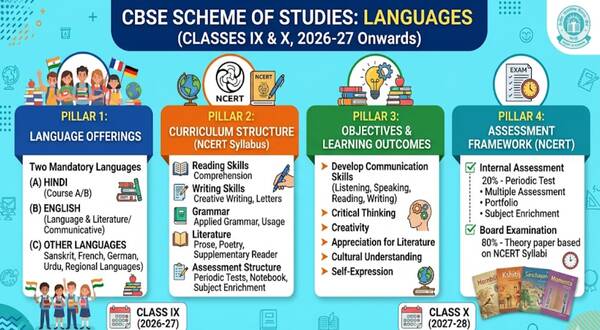
Key amendments in the Scheme of Studies with respect to study of Languages With effect from 1st July 2026, for Class IX, the study of three languages (R1, R2, R3) shall be compulsory, with at least two languages being native Indian languages. Students who wish to study a foreign language may do so as the third language only if the other two languages are native Indian languages, or as an additional fourth language. The detailed scheme is available on www.cbseacademic.nic.in .
Pedagogy and Resources
As Head of School, all Principals are requested to carefully read the NCFSE-23 Curricular Goals, Competencies and Learning Outcomes for Language as well as other subjects. Comparative analysis shows approximately 75–80% overlap in core language competencies (oral communication, reading comprehension, written expression, and grammatical awareness) between Middle Stage and Secondary Stage R3. Accordingly, till the dedicated R3 textbooks are available, Class IX students shall use the Class VI R3 textbooks (2026–27 edition) of the chosen language. In order to adequately address the competencies envisaged at the Secondary Stage, these textbooks will be supplemented with one appropriate local or state literary material, selected by schools, such as short stories, poems, or non- fiction works. Detailed guidelines regarding the selection and pedagogical use of such supplementary literary material shall be issued by CBSE by 15 June 2026.
Class VI R3 Textbooks in 19 scheduled languages (list enclosed) will be made available to schools before 1st July. For the remaining native Indian languages, available SCERT and State level resources may be used, as per past practice.
Schools facing constraints in the availability of adequately qualified native Indian language teachers may, as an interim arrangement for R3 Language, engage existing teachers of other subjects who possess functional proficiency in the concerned native Indian language. Collaborative and flexible mechanisms such as inter-school resource sharing through Sahodaya clusters, virtual or hybrid teaching support, engagement of retired language teachers, and utilisation of suitably qualified postgraduates may be adopted to address temporary teacher availability challenges during the transition period.
Assessment
To keep the focus on learning and reduce any undue pressure on students, no Board Examination shall be conducted for R3 at the Class X level. All assessments for R3 shall be entirely school-based and internal. The performance of students in R3 will be duly reflected in the CBSE certificate. It is clarified that no student will be barred from appearing in the Class X Board Examinations due to R3. Sample question papers, rubrics for internal assessment will be shared by the Board shortly.
School Autonomy and OASIS Update
Schools may choose any language from the CBSE list of subjects, ensuring that at least two of R1, R2, R3 are native Indian languages. It is also requested that schools must update their R3 offering, as per policy recommendations, for classes VI to IX on the OASIS portal by 30th June 2026.
Exemptions and Special Provisions
- Children with Special Needs (CwSN) shall be granted relaxations as per the RPwD Act, 2016 (including exemption from second and/or third language where applicable).
- CBSE schools situated outside India.
- Foreign students coming back to India may be granted case-by-case exemptions from the requirement of two native Indian languages.
The Board reiterates that these transitional measures are designed solely to align with national policy while protecting student interests. No student shall be disadvantaged due to this alignment. The focus remains on joyful, meaningful language learning, not on examination pressure.
Schools are requested to communicate these provisions positively to teachers, students, and parents, emphasising the long-term benefits of multilingual proficiency and cultural rootedness.
For any clarification, schools may contact the CBSE Academic Unit at: [email protected] or approach us at 011-24050612.
(Dr. Praggya M. Singh)
Professor & Director (Academics)
Enclosure as above
Copy to the respective Heads of Directorates, Organisations and Institutions with a request to disseminate the information to all the schools under their jurisdiction:
1. The Commissioner, Kendriya Vidyalaya Sangathan, 18 Institutional Area, Shaheed Jeet Singh Marg, New Delhi-16
2. The Commissioner, Navodaya Vidyalaya Samiti, B-15, Sector-62, Institutional Area, Noida-201309
3. The Secretary, Eklavya Model Residential Schools (EMRS), Ministry of Tribal Affairs, Government of India.
4. The Secretary, Sainik Schools Society, Room No. 101, D-1 Wing, Sena Bhawan, New Delhi- 110001
5. The Chairman, Odisha Adarsha Vidyalaya Sangathan, N-1/9, Near Doordarshan Kendra, PO Sainik School Nayapalli, Bhubaneswar, Odisha-751005
6. The Director of Education, Directorate of Education, Govt. of NCT of Delhi, Old Secretariat, Delhi-110054
7. The Director of Public Instructions (Schools), Union Territory Secretariat, Sector 9, Chandigarh-160017
8. The Director of Education, Govt. of Sikkim, Gangtok, Sikkim –737101
9. The Director of School Education, Govt. of Arunachal Pradesh, Itanagar –791111
10. The Director of Education, Govt. of A&N Islands, Port Blair – 744101
11. The Director of School Education, Ladakh, Room No.101-102, Ground Floor, Council Secretariat, Kurbathang, Kargil – Ladakh
12. The Director of School Education, Andhra Pradesh, 3rd Floor, B block, Anjaneya Towers, VTPS Rd, Bhimaraju Gutta, Ibrahimpatnam, Andhra Pradesh – 521 456
13. The Director, Jharkhand Education Project Council, Old HEC High School, JSCA Stadium Road, Jagannathpur, Sector-III, Dhurwa, Ranchi-834004 (Jharkhand)
14. Navy Education Society, Dte of Naval Education, Naval Headquarters, Ministry of Defence, West Block-V, RK Puram, New Delhi-110066
15. The Additional Director General of Army Education, A –Wing, Sena Bhawan, DHQ, PO, New Delhi-110001
16. The Secretary AWES, Integrated Headquarters of MoD (Army), FDRC Building No. 202, Shankar Vihar (Near APS), Delhi Cantt-110010
17. DS to Chairperson, CBSE
18. Secretary/ Controller of Examinations/ All Directors, CBSE
19. All Regional Directors/ Regional Officers of CBSE with the request to send this circular to all the Heads of the affiliated schools of the Board in their respective regions
20. All Joint Secretary/ Deputy Secretary/ PPS/SPS/Under Secretary/ Assistant Secretary, CBSE
21. All Head(s)/ In-Charge(s), Centre of Excellence, CBSE
22. In charge IT Unit with the request to put this Circular on the CBSE Academic Website
23. In-Charge, Library
24. Record File
Professor & Director (Academics)
Source: Click here to view/download PDF
नोट :- हमारे वेबसाइट www.indiangovtscheme.com पर ऐसी जानकारी रोजाना आती रहती है, तो आप ऐसी ही सरकारी योजनाओं की जानकारी पाने के लिए हमारे वेबसाइट www.indiangovtscheme.com से जुड़े रहे।