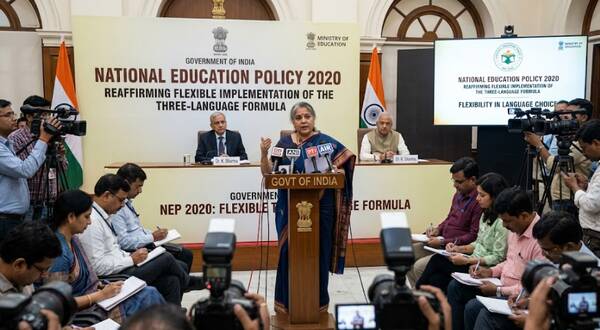
Government Reaffirms Flexible Implementation of Three-Language Formula Under NEP 2020
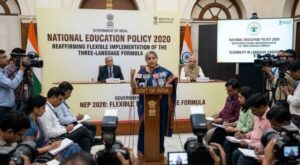
The Government of India has reiterated that the implementation of the three-language formula under the National Education Policy (NEP) 2020 will be guided by flexibility, respect for India’s linguistic diversity, and the constitutional rights of States. Responding to an Unstarred Question (No. 342) in the Rajya Sabha on 22 July 2026, Minister of State for Education Shri Jayant Chaudhary clarified the Government’s position on preparedness, implementation, and support mechanisms for the policy.
No Language Will Be Imposed
The Government emphasized that NEP 2020 does not mandate the imposition of any language on any State. Instead, the three-language formula allows States, regions, and students to determine their language choices, provided that at least two of the three languages are native to India.
The policy also provides flexibility for students to change one or more of their chosen languages in Grades 6 or 7, subject to demonstrating basic proficiency in three languages—including one Indian language at the literature level—by the end of secondary education.
National Curriculum Framework Provides the Roadmap
The National Curriculum Framework for School Education (NCF-SE) 2023 serves as the implementation framework for NEP 2020’s language policy. It outlines a phased multilingual learning approach:
- Foundational and Preparatory Stages: Students learn two languages, with at least one being an Indian language.
- Middle Stage and Secondary (Grades 9–10): Students study three languages, of which two must be native to India.
- Senior Secondary (Grades 11–12): Students continue with two languages, including at least one Indian language.
The framework identifies:
- R1: The first language, ideally the child’s mother tongue or the State language.
- R2: A second language different from R1.
- R3: A third language distinct from both R1 and R2.
The objective is to ensure students become independent speakers, readers, and writers in all three languages by different stages of schooling.
Early Multilingual Education
The Government cited research highlighted in NEP 2020 showing that children acquire languages most effectively between the ages of two and eight. Accordingly, schools are encouraged to expose children to multiple languages from the foundational stage, while placing particular emphasis on learning in the mother tongue during the early years.
The policy also recommends that language instruction be enjoyable, interactive, and conversation-based, gradually introducing reading and writing skills in additional languages from Grade 3 onwards.
Investment in Language Teachers and Technology
Recognizing implementation challenges, NEP 2020 calls for substantial investment by both the Central and State Governments in recruiting language teachers across regional languages, especially those listed in the Eighth Schedule of the Constitution.
The policy also encourages States from different regions to enter bilateral agreements to recruit language teachers from one another wherever necessary. Additionally, technology is expected to play a significant role in language teaching, digital learning resources, and expanding access to quality language education.
Extensive Consultations Before Policy Formulation
Responding to concerns about preparedness and assessment, the Government stated that extensive consultations preceded both NEP 2020 and the NCF-SE 2023. These consultations included:
- Experts and linguists
- State and national policymakers
- Curriculum developers
- Teachers and teacher educators
- Students and parents
- Non-governmental organizations
- Representatives from various school education systems
According to the Government, stakeholders from all States and regions participated through both in-person and digital consultations, and their views informed the final policy framework.
States to Decide Implementation Modalities
The Government reiterated that education is a subject under the Concurrent List of the Constitution. Consequently, individual States and Union Territories retain the authority to determine how the three-language policy will be implemented within their school systems.
States are expected to adopt the policy in accordance with the spirit of NEP 2020 while considering local linguistic diversity, regional aspirations, administrative capacity, and practical feasibility. The Centre has emphasized that multilingualism remains the guiding principle, but implementation should remain flexible and responsive to local needs.
Source: Click here to view/download PDF
नोट :- हमारे वेबसाइट indiangovtscheme.com पर ऐसी जानकारी रोजाना आती रहती है, तो आप ऐसी ही सरकारी योजनाओं की जानकारी पाने के लिए हमारे वेबसाइट indiangovtscheme.com से जुड़े रहे।