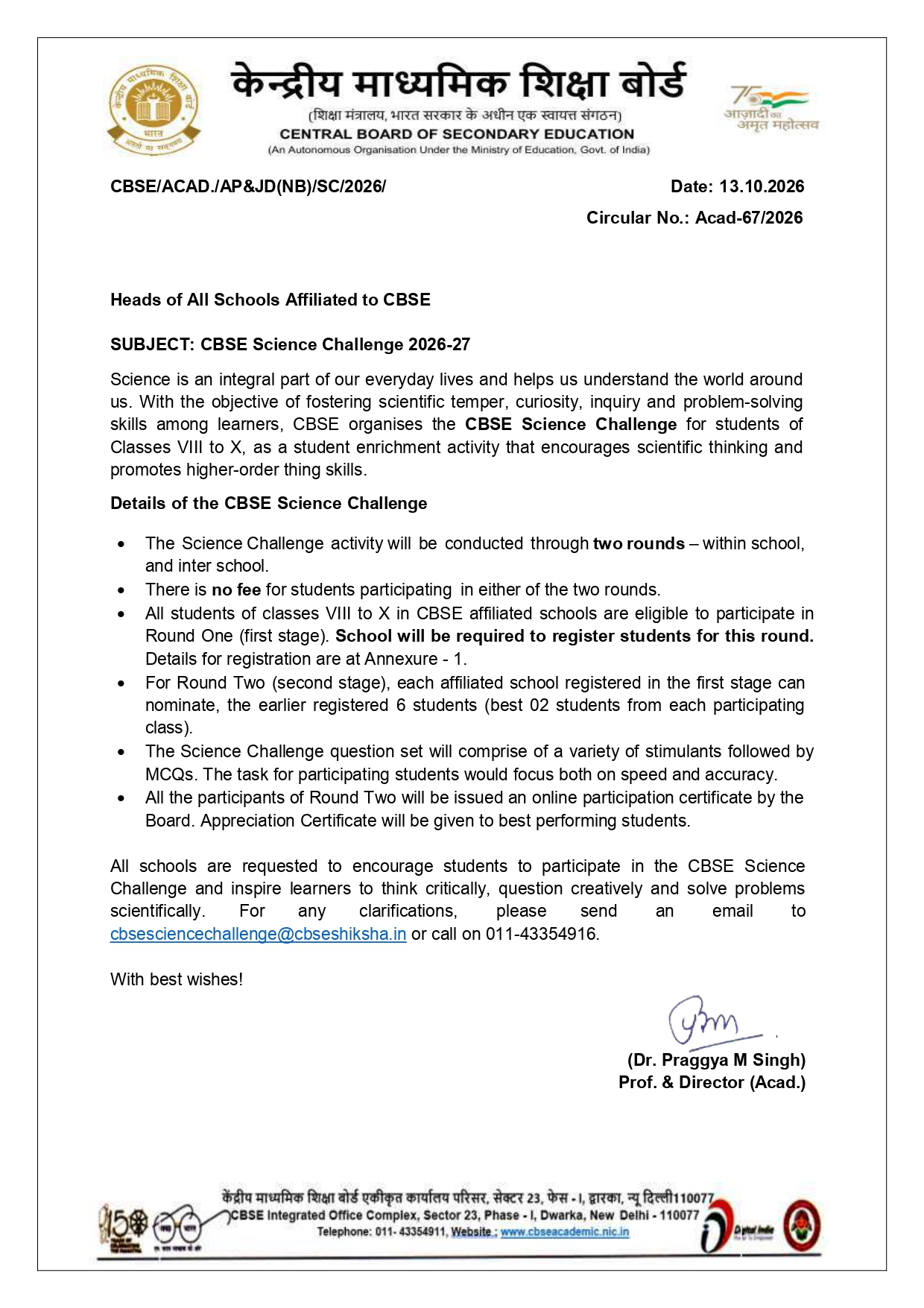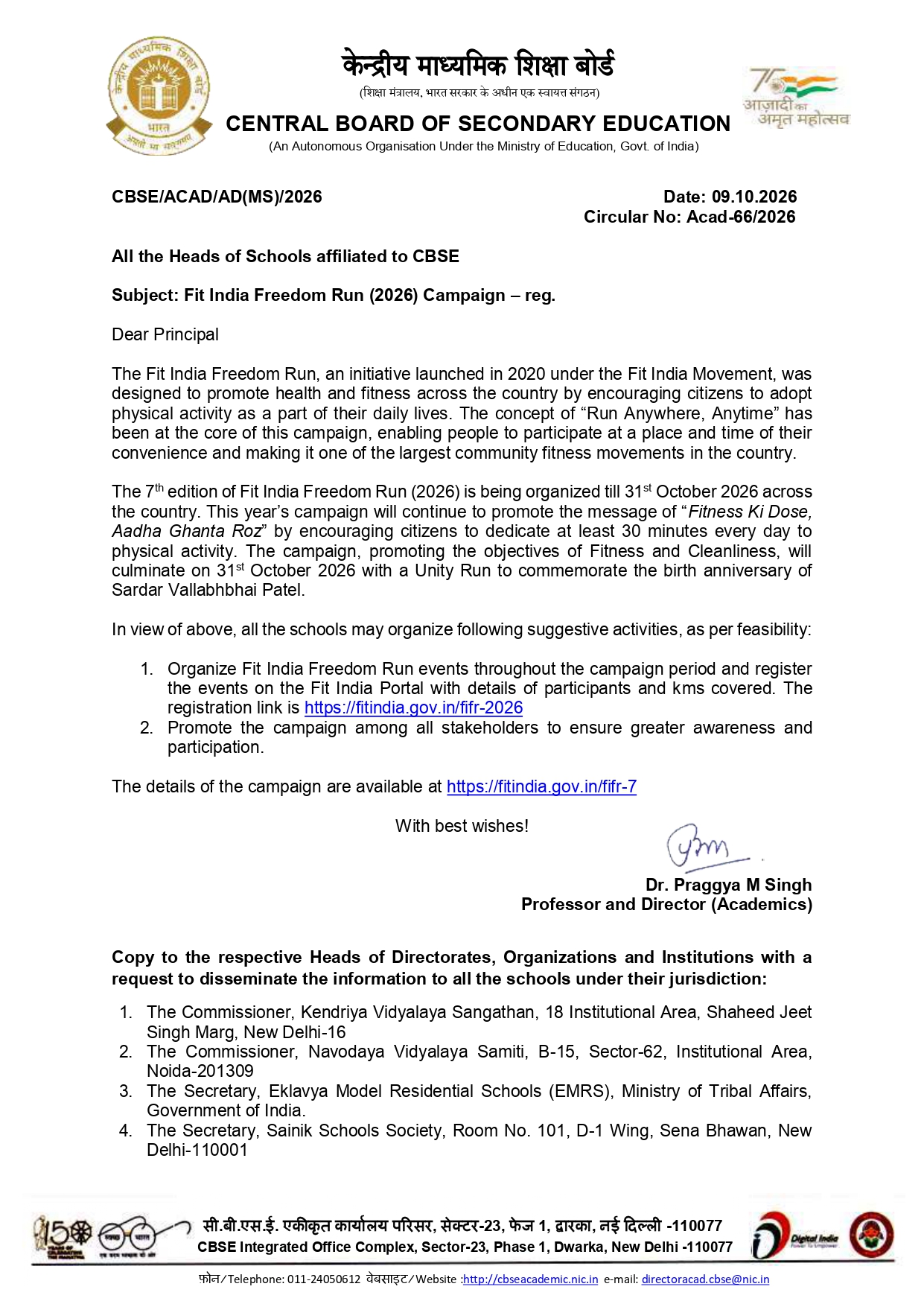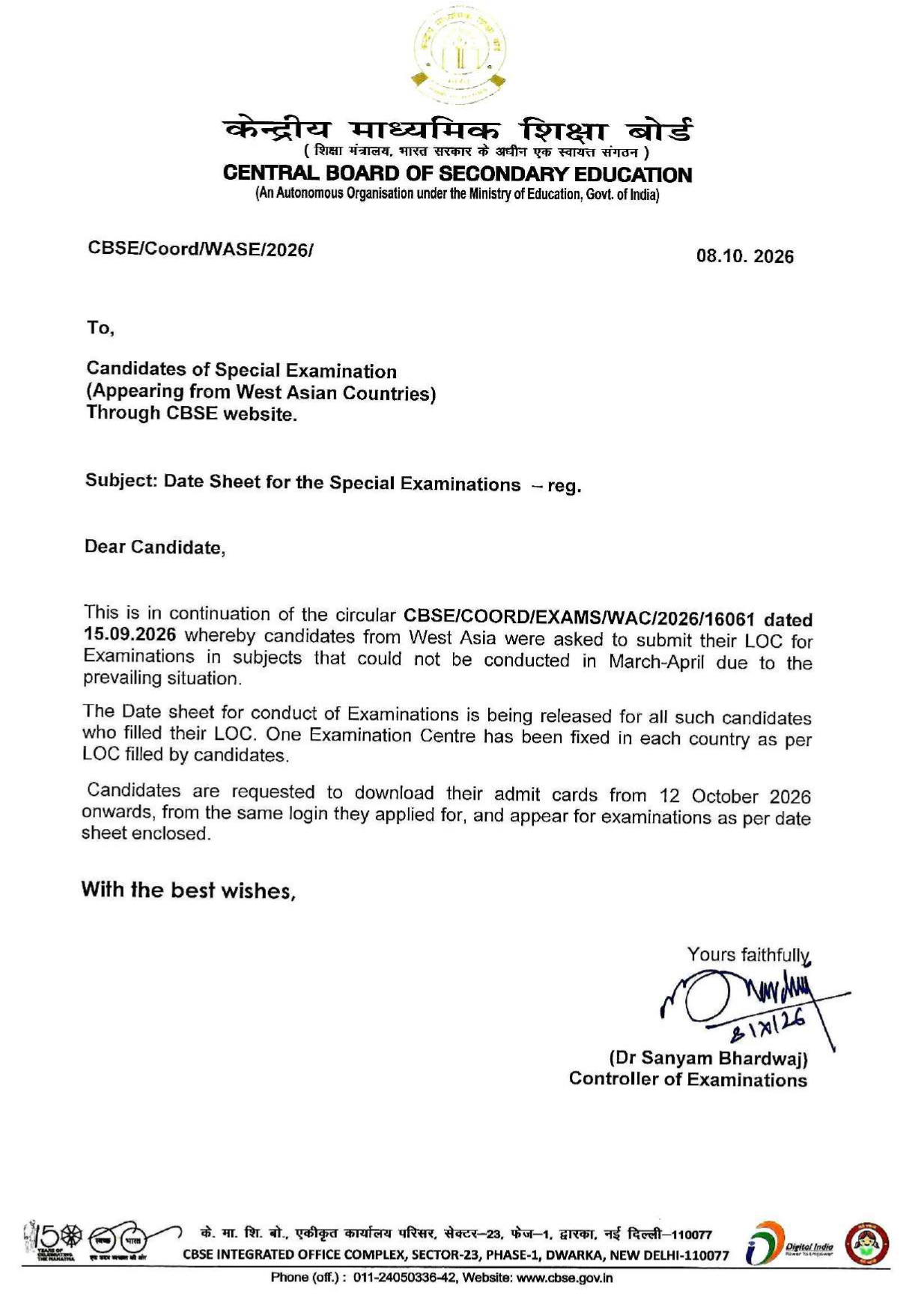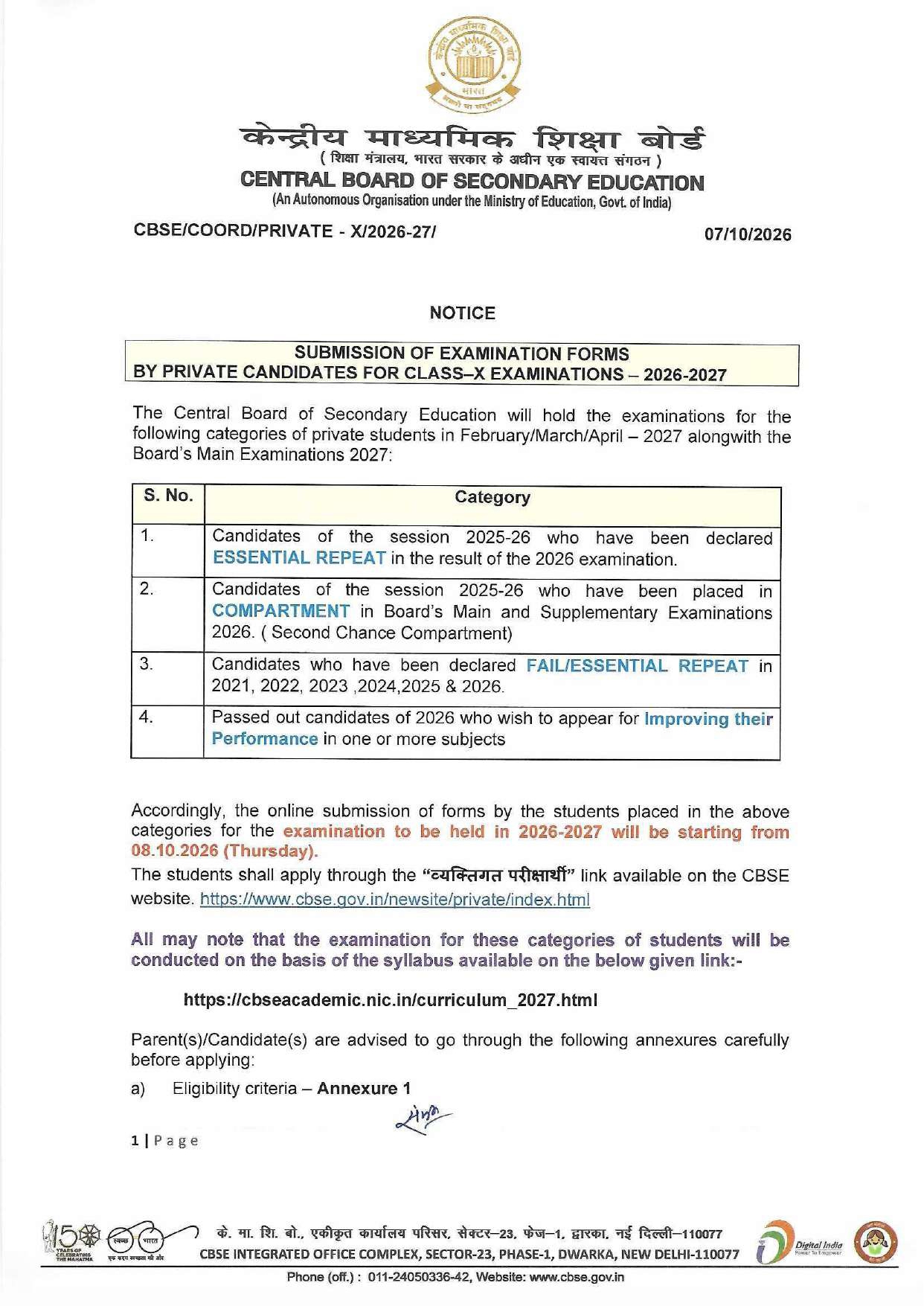

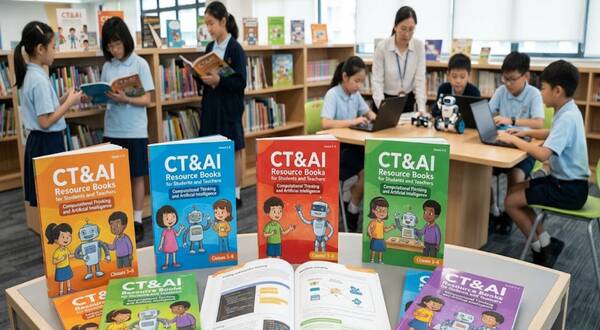
CT&AI Resource Books for Students and Teachers (Classes 3–8)
CBSE/ DIR(ACAD)/ 2026
April 9, 2026
Circular no. Acad-18/2026
Heads of all Institutions affiliated to CBSE
Subject: Students’ and Teachers’ Resource books for course on Computational Thinking and Artificial Intelligence (CT&AI) for classes 3rd to 8th
Dear Principal,
The National Education Policy (NEP) aims to position India as a leader in emerging knowledge fields by integrating technologies like AI, Machine Learning, Big Data and Computational Thinking into school education. It seeks to promote technology- enabled, interactive and gamified learning using tools such as Augmented Reality (AR), Virtual Reality (VR), and virtual labs to foster creativity, problem-solving, and interdisciplinary exploration. NCFSE 23 carries this recommendation further for implementation.
While Artificial Intelligence (AI) is an important requirement, Computational Thinking (CT) should be a broader skill, developing a foundation for learning AI. It can cover various aspects like Cybersecurity, basic network, etc. Hence, CBSE approaches this by integrating computational thinking with AI and other technological advancements, without dependence on any platform.
Learners engage with problems involving powers and number systems, proportional reasoning, geometric configurations and structured distributions, requiring decomposition of multi-variable scenarios, identification of complex patterns and design of stepwise algorithms under constraints. The Artificial Intelligence component deepens understanding of the AI project lifecycle, data-driven decision- making and ethical considerations such as bias and fairness, enabling students to critically analyse how data and models influence outcomes.
CBSE has released the curriculum framework for CT &AI, for students of classes 3rd to 8th, with the aim of creating AI-literate learners by 2030. The curriculum mandates CT + AI + Ethics + Unplugged Learning. All other courses on AI being run till the session 2025-26 are being discontinued for class IX, session 2026-27 onwards. Students of class X for the session 2026-27 will continue with the scheme followed in the session 2025-26. NCERT shall provide modules on CT& AI for classes 9th to 12th for the session 2026-27 to be transacted as modules for internal assessment.
The Students’ and Teachers’ Handbooks for CT& AI classes 3rd to 8th are now available on http://cbseacademic.nic.in/ . These resource books are not designed as textbooks, but rather as a companion to the NCERT Mathematics textbooks (the concepts of TWAU are interwoven), and are intended to be used alongside regular classroom teaching. Since they follow the same chapter sequence as in Mathematics, the subject teacher can seamlessly integrate them into daily instruction. As concepts are introduced in class, the corresponding questions from this book can be used to deepen understanding and encourage application. Schools should download these resource books and use these for classroom transaction.
Before beginning a chapter, the teacher is encouraged to go through the content of the book, identify the underlying concepts required for each question, and plan how to align them with classroom teaching. As these concepts are taught, the teacher can introduce the related thinking questions to students.
It is important to note that the questions in the books are thinking-based and designed to promote analysis, reasoning, and problem-solving. Teachers should adopt a facilitative approach, guiding students through prompts and discussions rather than directly providing solutions. Students should be given time to think and attempt independently, followed by classroom discussions where different approaches are shared and explored.
Some chapters also include activities that build intuition and engagement. These should be conducted before attempting the questions, as they help students approach the problems with better understanding.
Teachers should approach this book with the mindset that the process of thinking is more important than arriving at the correct answer. Creating a safe and encouraging environment where students feel comfortable making mistakes, exploring multiple strategies, and expressing their reasoning is essential. The goal is to nurture confident, independent thinkers rather than focus solely on correctness.
Dr. Praggya M. Singh
Professor & Director (Academics)
Copy to the respective Heads of Directorates, Organizations and Institutions as indicated below with a request to disseminate the information to all the schools under their jurisdiction:
1. The Commissioner, Kendriya Vidyalaya Sangathan, 18 Institutional Area, Shaheed Jeet Singh Marg, New Delhi-16
2. The Commissioner, Navodaya Vidyalaya Samiti, B-15, Sector-62, Institutional Area, Noida -201309
3. The Secretary, Eklavya Model Residential Schools (EMRS), Ministry of Tribal Affairs, Government of India.
4. The Secretary, Sainik Schools Society, Room No. 101, D-1 Wing, Sena Bhawan, New Delhi-110001
5. The Chairman, Odisha Adarsha Vidyalaya Sangathan, N-1/9, Near Doordarshan Kendra, PO Sainik School Nayapalli, Bhubaneswar, Odhisha-751005
6. The Director of Education, Directorate of Education, Govt. of NCT of Delhi, Old Secretariat, Delhi-110 054
7. The Director of Public Instructions (Schools), Union Territory Secretariat, Sector 9, Chandigarh-160017
8. The Director of Education, Govt. of Sikkim, Gangtok, Sikkim –737101
9. The Director of School Education, Govt. of Arunachal Pradesh, Itanagar –791 111
10. The Director of Education, Govt. of A&N Islands, Port Blair – 744101
11. The Director of School Education, Ladakh, Room No.101-102, Ground Floor, Council Secretariat, Kurbathang, Kargil – Ladakh
12. The Director of School Education, Andhra Pradesh, 3rd Floor, B block, Anjaneya Towers, VTPS Rd, Bhimaraju Gutta, Ibrahimpatnam, Andhra Pradesh – 521 456
13. The Director, Central Tibetan School Administration, ESSESS Plaza, Community Centre, Sector -3, Rohini, Delhi
14. The Additional Director General of Army Education, A –Wing, Sena Bhawan, DHQ, PO, New Delhi-110001
15. The Secretary AWES, Integrated Headquarters of MoD (Army), FDRC Building No. 202, Shankar Vihar (Near APS), Delhi Cantt-110010
17. DS to Chairperson, CBSE
18. Secretary/ Controller of Examinations/ All Directors, CBSE
19. All Regional Directors/ Regional Officers of CBSE with the request to send this circular to all the Heads of the affiliated schools of the Board in their respective regions
20. All Joint Secretary/ Deputy Secretary/ PPS/SPS/Under Secretary/Assistant Secretary, CBSE
21. All Head(s)/ In-Charge(s), Centre of Excellence, CBSE
22. In charge IT Unit with the request to put this Circular on the CBSE Academic Website
23. In-Charge, Library
24. Record File
Professor & Director
(Academics)
Source: Click here to view/download PDF
नोट :- हमारे वेबसाइट www.indiangovtscheme.com पर ऐसी जानकारी रोजाना आती रहती है, तो आप ऐसी ही सरकारी योजनाओं की जानकारी पाने के लिए हमारे वेबसाइट www.indiangovtscheme.com से जुड़े रहे।