Indian Govt Scheme – Sarkari Yojna

Information about latest Indian Government Schemes provided by Modi Government. Various Scheme by Niti Ayog i.e. Pradhan Mantri Awas Yojna, Ujjwala Yojna etc.

Rashtriya Uchchatar Shiksha Abhiyan (RUSA) Scheme राष्ट्रीय उच्चतर शिक्षा अभियान (रूसा) योजना

Rashtriya Uchchatar Shiksha Abhiyan (RUSA) Scheme to continue till 31st March, 2026 approved by Government राष्ट्रीय उच्चतर शिक्षा अभियान (रूसा) योजना को 31 मार्च, 2026 तक जारी रखने की मंजूरी दी

Ministry of Education शिक्षा मंत्रालय

Government approves Rashtriya Uchchatar Shiksha Abhiyan (RUSA) Scheme to continue till 31st March, 2026

सरकार ने राष्ट्रीय उच्चतर शिक्षा अभियान (रूसा) योजना को 31 मार्च, 2026 तक जारी रखने की मंजूरी दी

Posted On: 18 FEB 2022 5:07PM by PIB Delhi

The Government has approved the scheme of Rashtriya Uchchatar Shiksha Abhiyan (RUSA) for continuation till 31.03.2026 or till further review, whichever is earlier. The proposal entails an expenditure of Rs. 12929.16 crore out of which Central Share is Rs. 8120.97 crores and the State Share is of Rs. 4808.19 crores. It has been envisaged to support around 1600 projects under the new phase of the scheme.
Rashtriya Uchchatar Shiksha Abhiyan

सरकार ने राष्ट्रीय उच्चतर शिक्षा अभियान (रूसा) योजना को 31 मार्च, 2026 या अगली समीक्षा तक, जो भी पहले हो, जारी रखने की मंजूरी दे दी है। इस प्रस्ताव में 12929.16 करोड़ रुपये का खर्च शामिल है। इसमें से केन्द्र का हिस्सा 8120.97 करोड़ रुपये और राज्यों का हिस्सा 4808.19 करोड़ रुपये का है। इस योजना के नए चरण के तहत लगभग 1600 परियोजनाओं को सहायता देने की परिकल्पना की गई है।

Rashtriya Uchchatar Shiksha Abhiyan (RUSA), a Centrally Sponsored Scheme (CSS) is an overarching scheme, operating in mission mode for funding the state government universities and colleges to achieve the aims of equity, access and excellence.

राष्ट्रीय उच्चतर शिक्षा अभियान (रूसा) एक केन्द्र प्रायोजित योजना (सीएसएस) है। यह व्यापक योजना समानता, पहुंच और उत्कृष्टता के लक्ष्यों को प्राप्त करने के उद्देश्य से राज्य सरकार के विश्वविद्यालयों और कॉलेजों का वित्त पोषण करने के लिए मिशन मोड में काम कर रही है।

New phase of RUSA targets to reach out the unserved, underserved areas; remote/ rural areas; difficult geographies; LWE areas; NER; aspirational districts, tier-2 cities,  areas with low GER etc., and to benefit the most disadvantaged areas and SEDGs.

रूसा के नए चरण का लक्ष्य सुविधा से वंचित क्षेत्रों, अपेक्षाकृत कम सुविधा वाले क्षेत्रों; दूरदराज/ग्रामीण क्षेत्रों; कठिन भौगोलिक स्थिति वाले क्षेत्रों; वामपंथी उग्रवाद (एलडब्ल्यूई) से प्रभावित क्षेत्र; उत्तर पूर्वी क्षेत्र (एनईआर); आकांक्षी जिलों, द्वितीय श्रेणी (टियर-2) के शहरों, कम जीईआर वाले क्षेत्रों आदि तक पहुंचना और सबसे अधिक वंचित क्षेत्रों एवं एसईडीजी को लाभ पहुंचाना है।

The new phase of the scheme has been designed to implement some of the recommendations and aims of the New Education Policy, which suggests some key changes to the current higher education system to revamp and re-energize it and thereby deliver quality higher education, with equity and inclusion.

इस योजना के नए चरण को नई शिक्षा नीति की उन सिफारिशों और उद्देश्यों को लागू करने के लिए डिज़ाइन किया गया है, जोकि वर्तमान उच्च शिक्षा प्रणाली में कुछ महत्वपूर्ण बदलावों का सुझाव देते हैं ताकि इस प्रणाली में सुधार लाकर इसे फिर से सक्रिय किया जा सके और इस तरह समानता एवं समावेशन के साथ गुणवत्तापूर्ण उच्च शिक्षा की सुविधा प्रदान की जा सके।

Under the new phase of the scheme, State Governments will be supported for Gender inclusion, Equity Initiatives, ICT, Enhancing employability through vocationalisation & skill upgradation. States will also be supported for creation of new Model Degree Colleges. State Universities will be supported for Multi-Disciplinary Education and Research. Grants will be provided for strengthening both accredited and non-accredited Universities and Colleges for undertaking various activities including teaching-learning in Indian languages.

इस योजना के नए चरण के तहत लैंगिक समावेशन, समानता संबंधी पहल, सूचना एवं संचार प्रौद्योगिकी (आईसीटी), व्यावसायिक शिक्षा एवं कौशल उन्नयन के माध्यम से रोजगार पाने की संभावना बढ़ाने के लिए राज्य सरकारों को सहायता प्रदान की जाएगी। राज्य सरकारों को नए मॉडल डिग्री कॉलेज बनाने के लिए भी सहयोग दिया जाएगा। बहु-विषयक शिक्षा और अनुसंधान के लिए राज्य के विश्वविद्यालयों को सहायता दी जाएगी। भारतीय भाषाओं में सिखाने-सीखने सहित विभिन्न गतिविधियों के लिए मान्यता प्राप्त और गैर-मान्यता प्राप्त विश्वविद्यालयों और कॉलेजों को मजबूती प्रदान करने के उद्देश्य से अनुदान प्रदान किया जाएगा।

नोट :- हमारे वेबसाइट www.indiangovtscheme.com पर ऐसी जानकारी रोजाना आती रहती है, तो आप ऐसी ही सरकारी योजनाओं की जानकारी पाने के लिए हमारे वेबसाइट www.indiangovtscheme.com से जुड़े रहे।

*****

Rashtriya Uchchatar Shiksha Abhiyan, RUSA is a Centrally Sponsored Scheme

Rashtriya Uchchatar Shiksha Abhiyan, RUSA is a Centrally Sponsored Scheme
The Ministry of Human Resource Development is the nodal agency administering the Rashtriya Uchchatar Shiksha Abhiyan (RUSA) program. It receives the budget targets of participating States, reviews/ analyzes them and then gives approvals and makes disbursements.

Rashtriya+Uchchatar+Shiksha

RUSA is a Centrally Sponsored Scheme (C.S.S.), launched in 2013 aims at providing strategic funding to eligible state Higher Educational Institutions. The Central Funding (in the ratio of 65:35 for General Category States and 90:10 for Special Category States) would be norm based and outcome dependent. The Funding would flow from the Central Ministry through the State Governments/ Union Territories to the State Higher Education Councils before reaching the identified Institutions. The Funding to States would be made on the basis of critical appraisal of State Higher Education Plans, which would describe each State’s strategy to address issues of equity, access and excellence in Higher Education.

[post_ads]

Vision:
To attain higher levels of access, equity and excellence in the State higher education system with greater efficiency, transparency, accountability and responsiveness.
Key Features:
  • Norm-based and performance-based funding.
  • Commitment by States and institutions to certain academic, administrative and governance reforms will be a precondition for receiving funding.
  • Funds would flow from the Ministry of Human Resource Development (M.H.R.D.) to universities and colleges, through the State governments.
  • Funding to the States would be made on the basis of critical appraisal of State Higher Education Plans (S.H.E.Ps). S.H.E.P. should address each State’s strategy to address issues of equity, access and excellence.
  • Each institution will have to prepare an Institutional Development Plan (I.D.P.) for all the components listed under the Scheme. It will be aggregated at the State level, after imposing a super layer of State relevant components into the S.H.E.P..
  • State higher education councils (S.H.E.C.) will have to undertake planning and evaluation, in addition to other monitoring and capacity building functions.
  • S.H.E.C. will be the key institution at the state level to channelize resources to the institutions from the State budget.
  • Two on-going Central schemes of Model Degree Colleges and submission on polytechnics will be subsumed under RUSA.
  • U.G.C. Schemes such as development grants for State universities and colleges, one-time catch up grants, etc. will be dove-tailed in RUSA. Individual oriented schemes would continue to be handled by U.G.C..
  • Centre-State funding would be in the ratio of 90:10 for North-Eastern States, Sikkim, Jammu and Kashmir, Himachal Pradesh and Uttarakhand and 65:35 for Other States and Union Territories (U.Ts).
  • Funding will be provided for government-aided institutions for permitted activities, based on certain norms and parameters, and in a ratio of 50:50.
  • States would be free to mobilize private sector participation (including donations and philanthropic grants) through innovative means, limited to a ceiling of 50% of the State share (see chapter 6 of RUSA document for more details).
  • State-wise allocations would be decided on the basis of a formulaic entitlement index which would factor in the population size of the relevant age group, G.E.R. and Gender Parity Index (G.P.I.) across categories, State expenditure on higher education, institutional density, teacher-student ratio, issues of access, equity and quality and excellence in higher education, etc. Further allocation of funds would be dependent upon performance of the state and its demonstrated commitment to the reforms agenda.

[post_ads_2]


Priorities and Strategies
  • The priorities of the state are:
  • Quality Assurance
  • Access and Equity
  • Infrastructure Development
  • Faculty Recruitment
  • Research and innovation
I. Quality assurance
  • N.A.A.C. assessment for all the institutions is mandatory. Only 12 Colleges of the state have been accredited so far.
  • Necessary grants is to be provided to help institutions within the state for undergoing assessment.
II. Access and Equity
  • Provide greater opportunities of access to Higher Education with equity to all the eligible persons and in particular to the vulnerable sections and rural population.
  • Expand access by supporting existing institutions, establishing new institutions, to remove imbalances that exist at present.
III. Infrastructure Development
  • Thrust on infrastructure development of institutions corresponding to their academic requirements
  • Necessary grants is to be provided on a need-based to the institutions within the state.
IV. Capacity Building in Students
  • Introduction of job oriented and industrially relevant courses / vocational courses (certificate, Diploma, Degree) to build capacities in students for self employments
  • Introducing Remedial classes/ Tutorials/ Career guidance
  • Necessary grants is to be provided to the institutions within the state having or willing to introduce such courses/ classes.
IV. Faculty Recruitment
  • High Teacher-Student ratio adversely affect quality teaching in the institutions of higher education.
  • To promote the quality of Higher Education by lowering the Teacher-Student ratio.
  • Incorporating I.C.T. based teaching – learning, virtual classroom to bridge the gaps of shortage of teachers.
  • Necessary grants is to be provided to the institutions with high Teacher-Student ratio or institutions introducing new courses/ classes.
V. Research and Innovation
  • Lack of opportunity for Research and Development/ limited publications;
  • Enhancing Library resource materials and Laboratories.
  • To promote Institutions/ Faculty way of providing grants and facilities that support research in different institutions
The Important strategies of the State are mandatory National Assessment and Accreditation Council [N.A.A.C.] assessment for all the institutions, assisting Higher Education Institutions to apply for accreditation, equitable access to all in Higher Education Institutions with enhanced access to the rural population, thrust on infrastructure development of colleges corresponding to their academic requirements, lowering of the Teacher: Student ratio, incorporating Information and Communication Technology based teaching – learning, virtual classroom to bridge the gaps of shortage of teachers, stimulating the research culture in Higher Educational Institutions and strengthening of Library resource materials/ Laboratories.
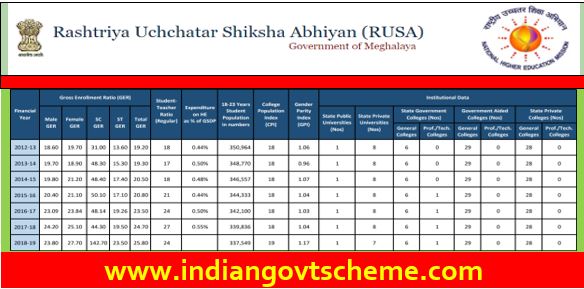
With the assistance under RUSA Scheme the state envisions an increase in the Gross Enrolment Ratio [G.E.R.], quality, access and equity in higher education and to build a system that is not only responsible for producing bright minds but can also support sophisticated research in a number of scientific and scholarly fields.
Source :http://rusameghalaya.nic.in


नोट :- हमारे वेबसाइट www.indiangovtscheme.com पर ऐसी जानकारी रोजाना आती रहती है, तो आप ऐसी ही सरकारी योजनाओं की जानकारी पाने के लिए हमारे वेबसाइट www.indiangovtscheme.com से जुड़े रहे
******
  • Facebook
  • X (Twitter)
  • LinkedIn
  • More Networks
Copy link