
8th Pay Commission, How a 5%-7% Annual Increment Could Boost Government Employees’ Salaries
The 8th Pay Commission (8th CPC) has intensified consultations with employee federations and pensioner associations as it moves forward with stakeholder meetings across the country. Following its two-day consultation in Jaipur, the Commission is scheduled to hold its next round of discussions in Chennai on September 7 and 8, where representatives of various Central Government employee organisations will once again present their key demands.
Among the most significant issues under discussion is the revision of the annual increment rate, which has remained unchanged at 3% since the implementation of the 7th Pay Commission. Employee organisations argue that the existing increment rate no longer reflects the rising cost of living and increasing financial responsibilities faced by government employees.
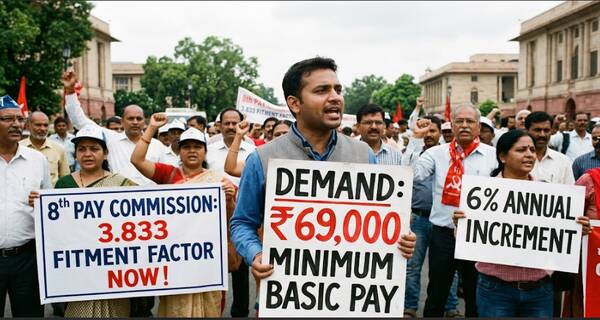
Employee Organisations Seek Higher Annual Increment
Several prominent employee federations have unanimously recommended increasing the annual increment rate. While most organisations have proposed a 6% annual increment, some have gone even further by demanding 7%.

Proposed Annual Increment Rates
| Organisation | Proposed Annual Increment |
| National Council of Joint Consultative Machinery (NC-JCM) | 6% |
| All India Defence Employees’ Federation (AIDEF) | 6% |
| Federation of National Postal Organisations (FNPO) | 6% |
| All India New Pension Scheme Employees’ Federation (AINPSEF) | 7% |
| Indian Railways’ Supervisors’ Association (IRTSA) | 5% |
The organisations contend that a higher increment rate would enable employees to better cope with inflation and improve their financial security throughout the pay commission period.
Why Employees Want an Increase
At present, Central Government employees receive an annual increment of 3% on their basic pay. Employee associations argue that this increase has become inadequate considering:
- Rising inflation and living costs.
- Increasing expenditure on housing, education, healthcare and transportation.
- Higher expenses for employees posted in metropolitan cities.
- Slow growth in basic pay over a 10-year pay commission cycle.
Although employees receive Dearness Allowance (DA), House Rent Allowance (HRA) and Transport Allowance (TPTA), many organisations believe these benefits are insufficient to offset increasing expenses.
Impact of the Current 3% Annual Increment
The existing increment structure results in only a gradual increase in basic salary over ten years.
Illustration under the 7th Pay Commission
| Pay Level | Starting Basic Pay | Basic Pay After 10 Years (3% Increment) |
| Level 1 | ₹18,000 | ₹23,500 |
| Level 2 | ₹19,900 | ₹26,000 |
| Level 3 | ₹21,700 | ₹28,400 |
| Level 4 | ₹25,500 | ₹33,300 |
| Level 5 | ₹29,200 | ₹38,100 |
Many employee bodies believe this increase does not adequately match inflation over a decade.
Estimated Salary Impact Under the 8th Pay Commission
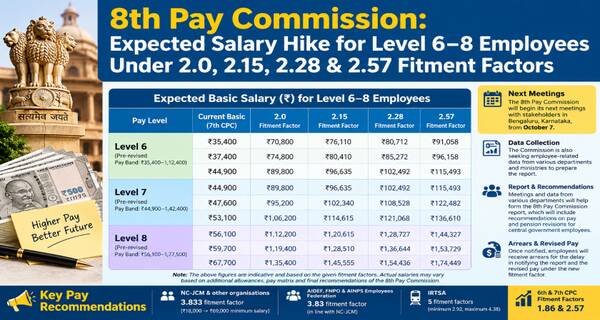
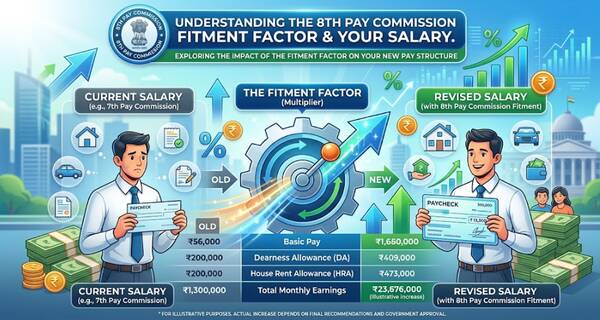
For illustration, consider a Level 8 employee currently drawing a basic pay of ₹47,600.
Assumptions
- Current Basic Pay: ₹47,600
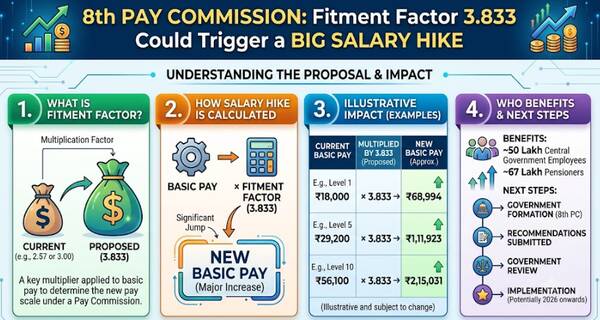
- Estimated Fitment Factor: 2.15
- Revised Basic Pay: ₹1,02,340
- Comparison period: 10 years
- Increment scenarios: 3%, 5%, 6% and 7%
10-Year Salary Comparison
| Annual Increment | Total Basic Salary in 10 Years | Additional Benefit over 3% |
| 3% | ₹1,40,78,561 | — |
| 5% | ₹1,54,46,658 | ₹13,68,097 |
| 6% | ₹1,61,87,071 | ₹21,08,510 |
| 7% | ₹1,69,67,703 | ₹28,89,143 |
Monthly Basic Pay After 10 Years
| Increment Rate | Monthly Basic Pay (Year 10) |
| 3% | ₹1,33,530 |
| 5% | ₹1,58,763 |
| 6% | ₹1,72,901 |
| 7% | ₹1,88,148 |
The figures demonstrate that even a 2-4 percentage point increase in the annual increment rate could substantially enhance employees’ earnings over the pay commission period.
Estimated Gain Over the Existing 3% Increment
| Increment Rate | Estimated Additional Salary | Increase Compared to 3% |
| 5% | ₹13.68 lakh | 9.72% more |
| 6% | ₹21.08 lakh | 14.98% more |
| 7% | ₹28.89 lakh | 20.52% more |
What Lies Ahead?
The recommendations submitted by employee organisations will be examined by the 8th Pay Commission during its ongoing consultations. Whether the Commission accepts a higher annual increment rate—and if so, what percentage it ultimately recommends—will become clear only after it submits its report to the Central Government.
Any revision in the annual increment rate would not only increase employees’ monthly basic pay but would also positively impact Dearness Allowance, House Rent Allowance, pension, gratuity and other retirement benefits, all of which are linked to basic pay.
Conclusion
The demand for increasing the annual increment from 3% to 5%, 6% or even 7% has emerged as one of the major issues before the 8th Pay Commission. The illustrative calculations indicate that a higher increment rate could provide significantly higher lifetime earnings, improving the financial well-being of Central Government employees.
However, these figures are illustrative estimates based on an assumed 2.15 fitment factor and projected increment rates. The actual benefits will depend on the final recommendations of the 8th Pay Commission and the subsequent approval by the Central Government.
Source: https://timesofindia.indiatimes.com/business/india-business/8th-pay-commission-salary-hike-calculator-a-level-8-employee-could-earn-up-to-rs-28-89-lakh-extra-over-10-years-if-annual-increment-rises-from-3-to-7-with-2-15-fitment-factor/articleshow/133740989.cms
नोट :- हमारे वेबसाइट www.indiangovtscheme.com पर ऐसी जानकारी रोजाना आती रहती है, तो आप ऐसी ही सरकारी योजनाओं की जानकारी पाने के लिए हमारे वेबसाइट www.indiangovtscheme.com से जुड़े रहे।