
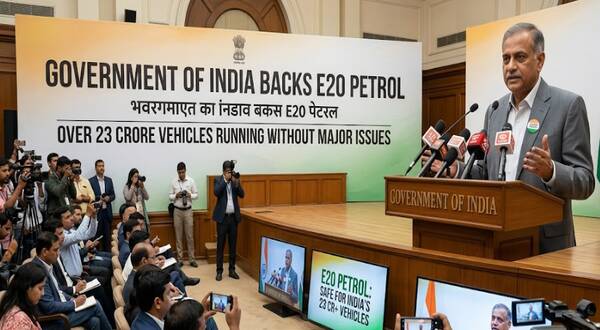
Government Backs E20 Petrol, Says Over 23 Crore Vehicles Running Without Major Issues
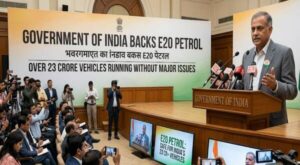
The Central Government has clarified in the Lok Sabha that it has no immediate plans to increase the mandatory ethanol blending level in petrol beyond 20% (E20), while reaffirming that E20 fuel has undergone extensive scientific validation and is safe for use in petrol vehicles when used according to manufacturer recommendations.
Responding to Lok Sabha Unstarred Question No. 776, Minister of State for Petroleum and Natural Gas Suresh Gopi stated that any future move toward higher ethanol blends such as E30 would only be considered after detailed scientific studies and consultations with stakeholders, including automobile manufacturers, oil marketing companies (OMCs), and research institutions.
No Nationwide E30 Plan, E85 Only for Flex-Fuel Vehicles
The Government emphasized that while E85 fuel (85% ethanol and 15% petrol) has been introduced in India, it is intended only for certified Flex Fuel Vehicles (FFVs) and does not represent an increase in the country’s standard petrol blending level.
The ethanol blending programme has steadily expanded over recent years:
|
Ethanol Supply Year |
Average Ethanol Blending |
| 2022–23 | Around 12% |
| 2023–24 | Around 14.6% |
| 2024–25 | Around 19.2% |
| 2025–26 (Nov–June) | 20% |
India achieved its 20% blending target five years ahead of schedule, marking a significant milestone in the Ethanol Blended Petrol (EBP) Programme.
Government Rejects Claims of Widespread Engine Damage
Addressing concerns about vehicle performance and durability, the Government said it has not received any widespread or substantiated complaints from automobile manufacturers, industry associations, or consumer organizations regarding engine damage, corrosion, reduced vehicle life, or abnormal wear attributable to E20 fuel.
According to the Ministry, more than:
- 20 crore two-wheelers, and
- Over 3 crore petrol cars have been operating on ethanol-blended petrol without verified evidence of widespread engine failures linked to E20.
The Government cited service records from major automobile manufacturers showing that even older, non-E20-certified vehicles have not exhibited abnormal corrosion, excessive wear, or reduced lifespan because of ethanol-blended petrol.
One leading passenger vehicle manufacturer reportedly serviced 2.84 crore vehicles during FY 2025–26, including approximately 1.5 crore older vehicles, without identifying E20-related engine damage. Similarly, a major two-wheeler manufacturer found no higher incidence of fuel-related damage compared with earlier petrol blends.
Scientific Studies Support E20 Rollout
The Ministry stated that India’s E20 programme was developed through extensive collaboration involving:
- NITI Aayog
- Automotive Research Association of India (ARAI)
- Society of Indian Automobile Manufacturers (SIAM)
- Indian Institute of Petroleum (IIP)
- Oil Marketing Companies (OMCs)
- Automobile manufacturers and component suppliers
According to the Government, laboratory testing, field validation, and real-world operating experience confirmed that E20:
- Does not cause abnormal engine wear.
- Does not create significant compatibility issues.
- Meets durability and emissions standards.
- Improves combustion efficiency.
- Offers higher octane value and better anti-knock performance.
The Ministry also stated that manufacturers continue to honour vehicle warranties for vehicles using E20 fuel.
Mileage May Reduce Slightly in Older Vehicles
While acknowledging concerns regarding fuel economy, the Government noted that fuel efficiency depends on several factors, including driving conditions, maintenance, and driving habits.
It said studies indicate that older vehicles originally designed for E10 petrol may experience a fuel economy reduction of around 3–5%, but maintained that E20 provides cleaner combustion and smoother engine performance overall.
The Government also cited findings from SIAM and ARAI suggesting that E20 improves acceleration and ride quality while reducing carbon emissions.
No Return to E10 or E0 Petrol
The Ministry categorically ruled out any proposal to reintroduce nationwide supplies of E0 or E10 petrol.
According to the Government, maintaining separate nationwide supply chains for E0, E10, and E20 across more than one lakh fuel stations would significantly increase logistics, storage, inventory, and operational costs.
The Ministry stated that public policy should move toward “cleaner and scientifically validated fuels” rather than reverting to older fuel standards.
Economic and Environmental Benefits
The Government highlighted several achievements of the Ethanol Blended Petrol Programme, claiming it has:
- Saved over ₹1.97 lakh crore in foreign exchange.
- Reduced crude oil imports by nearly 316 lakh metric tonnes.
- Lowered carbon dioxide emissions by approximately 952 lakh metric tonnes.
- Transferred more than ₹1.66 lakh crore to farmers through ethanol procurement.
The programme, the Ministry said, contributes to India’s energy security, supports rural incomes, and advances national climate objectives.
Consumer Grievance Mechanism
The Government said Oil Marketing Companies have established multiple channels for consumers to report fuel-related concerns, including:
- Complaint registers at petrol pumps.
- Toll-free customer care numbers.
- Company websites and mobile applications.
- Customer Relationship Management (CRM) systems.
- Social media platforms.
- Email support.
- The Centralized Public Grievance Redress and Monitoring System (CPGRAMS).
Officials stated that all complaints are investigated and resolved according to established procedures, while public awareness campaigns continue to educate consumers about E20 compatibility and its environmental benefits.
Looking Ahead
The Government reiterated that India’s transition to E20 has been gradual, scientifically validated, and developed in consultation with industry stakeholders. While higher ethanol blends remain under consideration for the future, any decision on E30 or beyond will depend on further scientific evaluation and stakeholder consultations. For now, the Government’s focus remains on consolidating the nationwide rollout of E20 as the country’s standard petrol blend.
Source: Click here to view/download PDF
नोट :- हमारे वेबसाइट www.indiangovtscheme.com पर ऐसी जानकारी रोजाना आती रहती है, तो आप ऐसी ही सरकारी योजनाओं की जानकारी पाने के लिए हमारे वेबसाइट www.indiangovtscheme.com से जुड़े रहे।